
SPC Flooring vs WPC Flooring: A Comparison of Features
In modern home renovation, SPC (StonePlastic Composite) flooring and WPC (WoodPlastic Composite) flooring, as newtype ecofriendly floor materials, are gradually replacing traditional solid wood flooring and ceramic tiles. Although both belong to the PVC flooring family, they differ significantly in core material, physical properties, environmentalprotection indicators and costperformance. This article will conduct an indepth analysis from multiple dimensions on why SPC flooring outperforms WPC flooring in overall performance.
Material Structure: StonePowder Core vs. Foamed WoodFiber Core
The core of SPC flooring is compacted by 60%80% natural stone powder (calcium carbonate) and PVC resin. Without adding any wood pulp or wood fibers, the substrate is dense, solid and hard enough to support heavy loads. The WPC core, however, is extruded at high temperatures from wood fibers, PVC resin and foaming agent. Abundant microbubbles distributed inside make the board softer. This fundamental structural discrepancy directly results in their distinct properties in density, hardness and longterm stability.
Wear Resistance: SPC Flooring Is LongerLasting
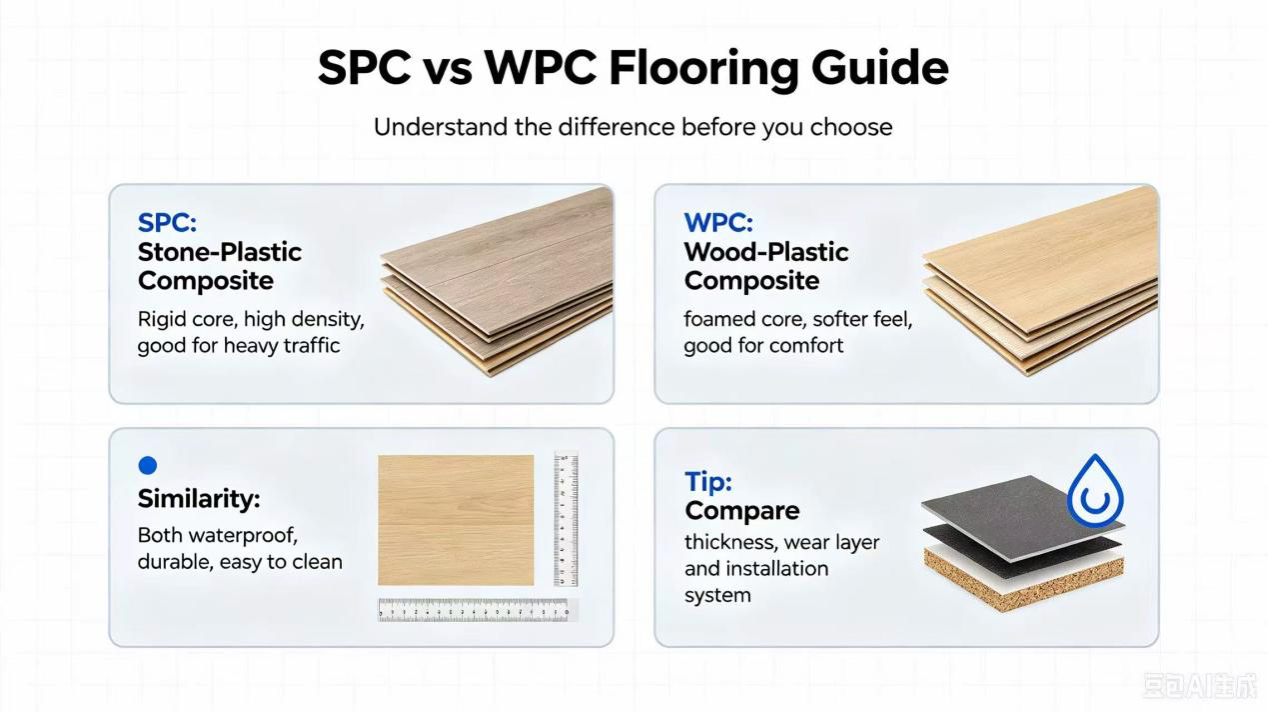
Wear resistance determines how long your floor will last. The highdensity stone powder core makes SPC much harder on the surface than WPC. Its wear layer is usually AC3AC5 rated, standing up to heavy foot traffic with little wear. WPC’s soft foamed core has poor impact resistance and dents easily when heavy items drop. SPC works much better for commercial areas or homes with pets and children.
Waterproof & Moisture Resistance: SPC Has a Denser Structure
Both SPC and WPC floors are 100% waterproof and can be used in wet places like kitchens and bathrooms. But WPC’s woodfiber core may absorb water and swell in persistent dampness, with a waterswelling rate of 0.8%1.5%. SPC has no hydrophilic fibers in its stonepowder core. Its waterswelling rate is under 0.1%, almost zero. It stays dimensionally stable even in extreme humidity.
Dimensional Stability: SPC Resists Deformation Far Better Than WPC
Flooring dimensional stability directly impacts its look and lifespan after installation. SPC’s stonepowder core has a very low thermal expansion coefficient. It hardly expands or shrinks with sharp temperature swings, avoiding joint gaps or buckling. WPC, with PVC and wood fibers sensitive to heat and cold, may warp at edges and have separated joints under direct sun or floor heating. It demands higherstandard installation and wider expansion gaps.
Environmental Safety
SPC is ZeroFormaldehyde, Safer for You Ecoperformance matters a lot for floor buyers. SPC is made of stone powder and PVC, no wood pulp or ureaformaldehyde glue in production. Formaldehyde emission is E0grade or even undetectable, with no heavy metals or phthalates. WPC contains wood fibers that need adhesives, which may release formaldehyde. It usually hits E1 standard, acceptable yet not as clean as SPC.
Easy Installation: SPC is Thinner, Saves More Space
SPC flooring is normally 3.57mm thick, thin but tough. You can install it right on top of old floors without demolition, saving ceiling height and installation time. The clicklock system works just like building blocks, gluefree and DIYfriendly. WPC is mostly 58 mm thick with softer foot feel. Its thicker profile is not ideal for oldhouse renovations with low ceiling height. Its softer core also demands a flatter subfloor before laying.
Price & CostPerformance: SPC Is More Competitive
Price greatly influences customers’ choices. Abundant stonepowder supplies and mature technology help SPC cut unit costs compared with WPC. In China’s market, SPC retails for 50120 CNY per ㎡, while WPC costs 100200 CNY/㎡ because of pricey wood fibers and foaming process. SPC provides superior physical performance at a lower cost, with remarkable valueformoney.
Application Comparison: SPC Covers More Scenarios
Thanks to its excellent wear resistance, waterproof property and dimensional stability, SPC flooring fits almost all indoor areas: living rooms, bedrooms, kitchens, bathrooms, shops, offices, hospitals and schools.
In residential living spaces, the high-density stone-powder core combined with an AC3–AC5 wear layer stands up effortlessly to daily wear and tear — heavy foot traffic, children playing, furniture being dragged across the floor, and the occasional dropped object all leave the surface essentially unharmed. Its low water absorption rate of under 0.1% means even a flooded kitchen, a leaking washing machine or steam from a long hot shower will not cause swelling, warping or delamination over time.
In commercial and public environments — retail shops, offices, hospitals and schools — SPC’s 15–25 year service life and minimal maintenance requirements translate directly into long-term cost savings. There is no need for periodic waxing, polishing or frequent replacement, and its excellent dimensional stability keeps seams tight even under continuous air-conditioning and heating cycles, preserving a clean, professional appearance year after year.
In old-house renovations, SPC can be installed directly over existing tiles or wooden floors without demolition, saving both time and labor while avoiding dust and debris — a decisive advantage for quick makeovers.
WPC flooring, on the other hand, has a softer foot feel and better sound insulation thanks to its foamed wood-fiber core, making it more suitable for cozy spaces like bedrooms where comfort underfoot and noise reduction are the top priorities. Its slightly cushioned surface feels warmer and gentler when walking barefoot, which some homeowners genuinely prefer.
However, WPC is not as good as SPC for commercial sites and damp environments. Its higher water absorption rate (0.8%–1.5%) poses a swelling risk in humid conditions, its softer surface is more prone to indentation from heavy furniture or dropped items, and its larger thermal expansion coefficient makes it less reliable under direct sunlight or underfloor heating. In such demanding scenarios, its long-term durability simply cannot match SPC.
SPC Flooring, the AllRound Better Option
To sum up the eight comparison points, SPC outperforms WPC overall in hardness, wear resistance, waterproof property, stability, environmental safety, easy installation, costefficiency and applicable scenarios. Supported by its highdensity stonepowder core, SPC is durable, stable, ecofriendly and affordable, perfect for home and commercial flooring.
WPC still has strengths in soft footfeel and noise reduction, and works well for bedrooms. But for balanced performance and longterm use, SPC is the smarter pick. With improved production techniques and richer designs, SPC is now the top flooring choice for more homes and projects.


Leave a Reply
Want to join the discussion?Feel free to contribute!